Introducing Hebno: AI for client work you can stand behind
5 minutes read
Most firms can already generate an AI draft. The hard part is turning that draft into work a client can rely on. Here is why we built Hebno, who it is for, and how it works.
Every expert service firm we talk to has already tried AI on real client work. Someone drafts a research summary in a chat window, someone else outlines a strategy deck, an analyst asks a model to pull a first cut of findings together. The draft arrives in seconds. Then the senior person opens it, and the real work starts.
They cannot tell where a claim came from. The context is generic, not this client's. Half of it is confident and wrong. So they rebuild it by hand, and the time AI was supposed to save goes into checking and correcting instead. The draft was fast, but it was not client-ready.
Hebno is for that gap.
What Hebno is
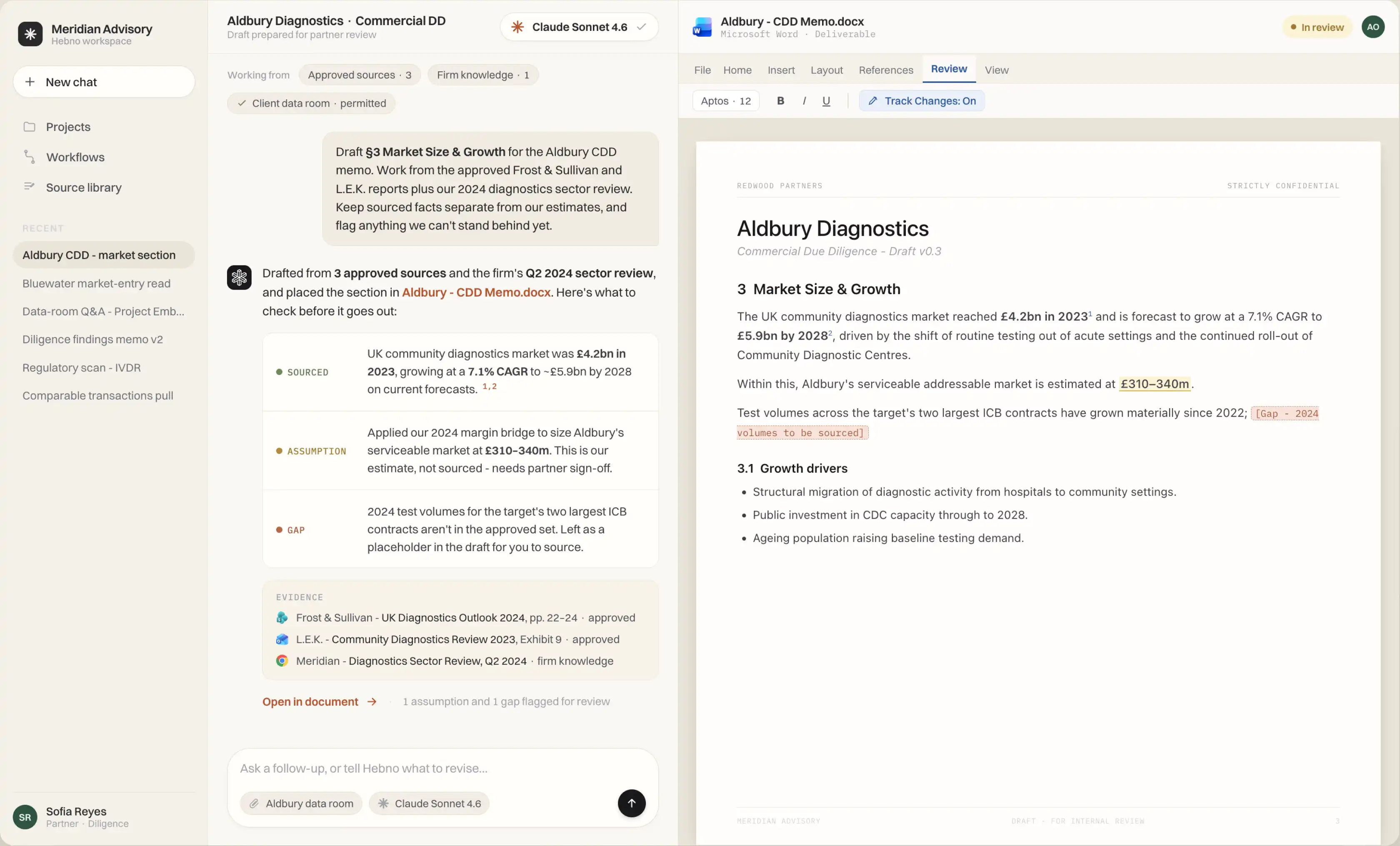
Hebno is a controlled AI work platform for expert service teams. It lets your team produce research, analysis, and first drafts with AI that work from your approved sources and your firm's own knowledge, and it keeps the result reviewable so an expert can check it and put their name on it before it reaches a client.
Your team can already get model access. The harder part is what happens after a promising draft arrives: can you see where each claim came from, can you tell a sourced claim from an assumption, and can a senior person review it without rebuilding it from scratch. That is what Hebno is built for.
The problem we kept seeing
A generic AI draft creates compounding problems in client delivery.
Claims in a chat reply have no evidence attached. For a firm whose product is judgement, an unsupported claim is a liability the reviewer has to run down before anything goes out.
The draft is also written from whatever the model already knows, not from this firm's methods, prior work, or the material this specific engagement is built on. So it reads plausible and generic, and a senior person has to put the real context back in.
And the quality is uneven, so review is slow. Some of the draft is right, some is invented, and nothing tells you which is which. The reviewer ends up checking everything, which is often slower than writing it fresh.
The tools built to help were mostly built for developers, or they stop at "here is a cited answer" and leave the rest to you. Neither fits a strategist, a researcher, or a consultant who has a client deadline and needs work they can defend.
How Hebno works
Hebno is built around four areas.
| The job | What Hebno does |
|---|---|
| Work you can stand behind | Research and first drafts from your approved sources, with the evidence behind each claim and the assumptions and open questions marked, built for expert review before delivery |
| Connected knowledge | Draws on your firm's prior work, methods, and permitted client material alongside external sources, and connects to the tools and data your firm already uses, under the access rules those tools already have |
| Reusable workflows and assistants | Turns a method that works into a repeatable workflow, so one good project becomes a process the rest of the team can run |
| The right model, at a cost you control | Uses the right model for each task within the models you allow, with usage visible by team and client and no surprise markups |
Reviewable work with the evidence attached is the core promise. Speed matters, but a fast draft you still cannot trust is not an improvement.
Hebno does not replace expert judgement or decide that a draft is correct or ready to send. It gives your experts a faster, more controlled way to apply their judgement, and the person reviewing the work remains accountable for it.
Who Hebno is for
Hebno is for consultancies doing client work that has to survive expert review. Research and insight consultancies are the sharpest fit, but the same problem shows up in strategy, creative, and advisory work.
The daily users are the people doing the delivery, the strategists, researchers, analysts, and knowledge leads. The reviewers are the client-service leaders accountable for what goes out. The buyers are usually founders, managing partners, and practice or operations leads. None of them care about model benchmarks. They care about delivery quality, work they can review and defend, and getting to a reliable draft faster.
If that is your firm, the complete guide to reliable AI client work is the best place to go deeper, and the consultancy playbook covers the client-by-client version of the problem.
How we think about pricing
Hebno is configured around how your firm delivers client work, so pricing is a tailored proposal rather than a public rate card. It reflects the size of your team, the workflows we set up, your source and integration needs, and your AI usage. AI usage is transparent, with no surprise markup on the models behind the work, and finance can always see the underlying cost by team and client. To discuss pricing, request a demo.
Where we are
We are early, and we are building in the open. The site describes the product we are building for expert service teams, and we would rather show you on your own work than talk about it in the abstract.