How to turn a working method into a reusable workflow
A method becomes a workflow the moment someone writes down what stays the same every time it runs. Here is what belongs in that document, and what a real one looks like.
Source-backed client work, connected knowledge, reusable workflows, and models at a cost you control - written for the people who own delivery.
A method becomes a workflow the moment someone writes down what stays the same every time it runs. Here is what belongs in that document, and what a real one looks like.
Most of a firm's knowledge is in SharePoint, Google Drive, Slack, and a dozen other places, not in a folder someone remembered to upload. Here is what connecting AI to that stack actually means.
A fast AI draft is not a finished one. What to check when you review AI-generated client work, and why firms that skip the check end up slower.
The open web holds everything at once, good and bad. Approved sources are the specific material a team has chosen to trust, and choosing them well is most of the work.
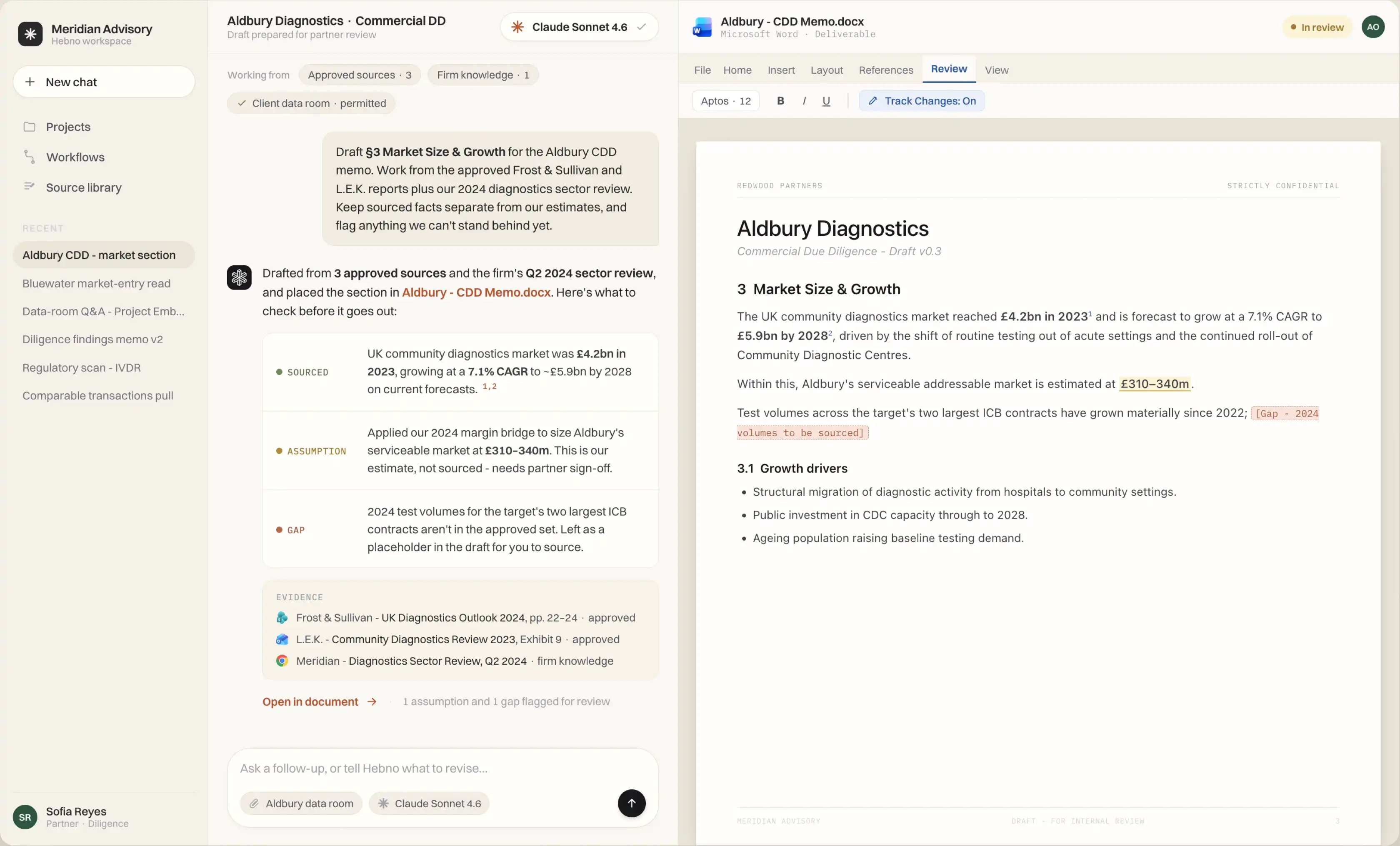
In an AI draft, a line backed by a real source sounds just as confident as a line the model filled in. Here is how to tell the two apart before review.
Once a firm uses AI on client work, the data questions become practical. What to hold any AI tool to, and how Hebno handles each one.
One person figures out a good way to do a piece of client work, and the knowledge leaves with them. With a reusable workflow, a proven method becomes a process the whole team can run.
AI that only knows what a public model was trained on writes generic drafts. Connected knowledge is how you make it work from what your firm actually knows.
Generic AI drafts are a bigger problem for consultancies, because the output goes straight to a paying client. A practical playbook for AI work you can bill for.
Which model runs a task, and what it costs, should be a controlled decision, not an accident of whichever tool someone opened. How to make both decisions on purpose.
A generic AI draft is fast but hard to deliver. This guide covers how expert service teams make AI output reliable enough to sign off: approved sources, visible evidence, and expert review.
Most firms can already generate an AI draft. The hard part is turning that draft into work a client can rely on. Here is why we built Hebno, who it is for, and how it works.

A short walkthrough of Hebno, shaped around the kind of work your team does.