

At a glance
Before you start
You need:- An owner or admin role in Hebno.
- Your Workday tenant name and the Workday REST API Endpoint and Token Endpoint shown in the View API Clients task.
- A Workday security administrator who can create an integration system user, a security group and an API client.
- Run Create Integration System User. Name it, for example
ISU_Hebno, set a password, clear Require New Password at Next Sign In and select Do Not Allow UI Sessions. - Run Create Security Group, choose Integration System Security Group (Unconstrained) and add the integration system user.
- Run Maintain Permissions for Security Group and grant Get access to the domains Worker Data: Public Worker Reports, Worker Data: Current Staffing Information and Worker Data: Time Off. Do not grant compensation, payroll, personal data or performance domains. Then run Activate Pending Security Policy Changes.
- Run Register API Client for Integrations, select Non-Expiring Refresh Tokens, and add the scopes below. Copy the client ID and client secret.
- Run Manage Refresh Tokens for Integrations for the integration system user and select Generate New Refresh Token. Copy the refresh token.
Connect Workday
1
Allow the integration
Open Admin → Connectors → Catalogue, find Workday under People and HR, and set it to Allow.
2
Connect the organisation
Select Connect, enter the tenant name, REST API endpoint, token endpoint, client ID, client secret and refresh token, then select Test connection. Hebno checks that it can read workers, organisations and time off.
3
Choose teams and data areas
Under Who can use it, choose All teams or pick teams. Under Data areas, choose what members can see. See Data areas.
Data areas
Data areas control what members of the allowed teams can see through the organisation connection. They apply on top of the integration system user’s security group in Workday.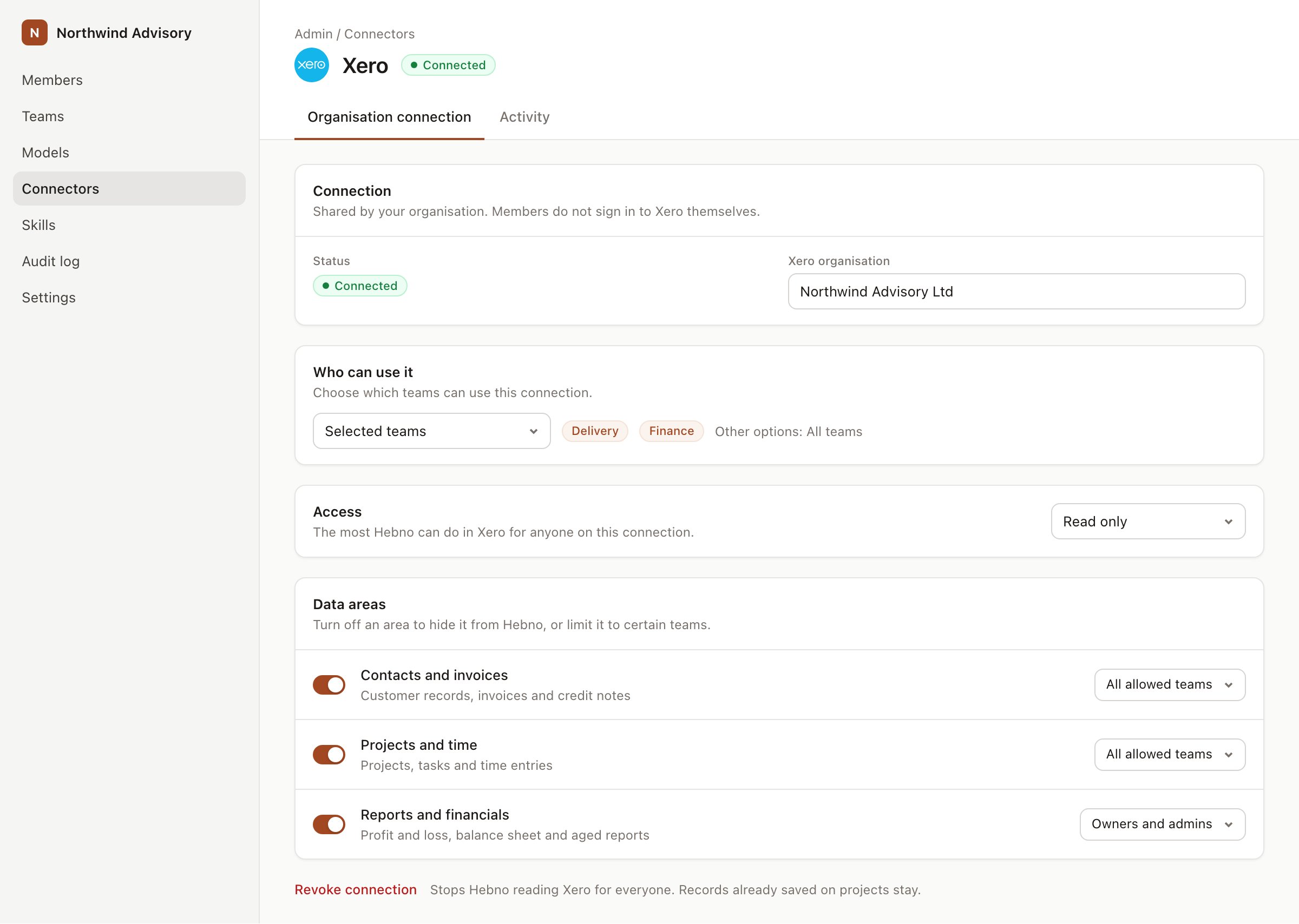
An organisation connection with team access and data areas. Financial figures default to owners and admins.
What Hebno reads
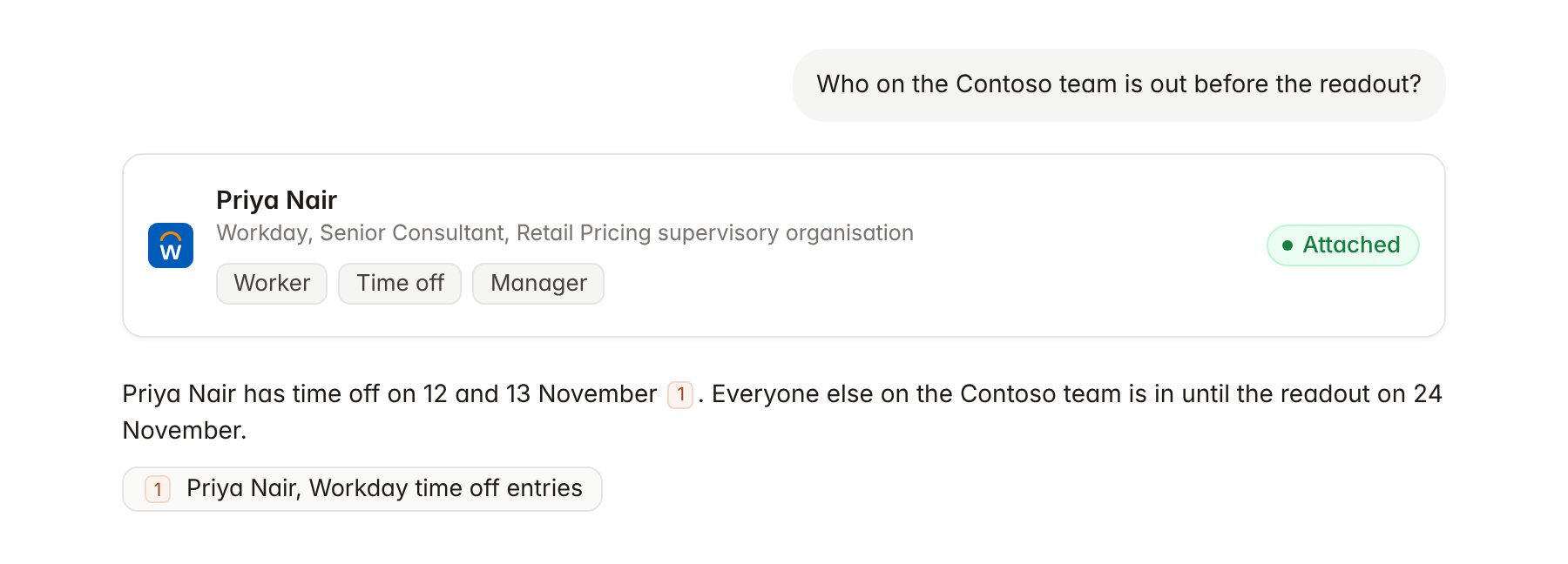
A Workday worker profile attached to a chat.
Hebno reads only
Hebno does not write to Workday. It does not request or approve time off, start business processes, edit workers, or change supervisory organisations. To book a consultant once you know they are free, use a resourcing integration such as Float.Link a project to its team
Linking marks which Workday workers are on a project, so you can ask “who on the team is away?” without naming everyone.- Open the project and select Brain.
- Under Linked records, select Link record, then Workday.
- Search by name or supervisory organisation, and select each worker. You can link a whole supervisory organisation instead.
Use Workday in chat
-
Attach: open the + menu, choose Sources → Workday, and pick a worker, a supervisory organisation or a time off period. Or type
/and choose Workday. -
Ask: name the person, organisation or period in your request. For example:
Who in the retail pricing organisation is out between 16 and 20 November?
List the Contoso project team with business titles, locations and managers.
Who reports to Sarah Chen, and is anyone on time off next week?
- Research runs show a Checking Workday step, with a chip for each worker and organisation it read.
- Agents can read Workday on a schedule, for example a Monday list of who is out on each active project this week.