

At a glance
Before you start
You need:- An owner or admin role in Hebno.
- A Fortnox user with system administrator rights in each Fortnox company you want to connect. Only a system administrator can activate an integration.
- The Fortnox licences for the areas you want to use: Fakturering (invoicing) for invoices and offers, Bokföring (bookkeeping) for vouchers and accounts, and Tid (time) for time reporting.
Permissions
Fortnox shows the scopes on its consent screen when you activate the integration.Connect Fortnox
1
Allow the integration
Open Admin → Connectors → Catalogue, find Fortnox under Finance, and set it to Allow.
2
Connect the organisation
Select Connect and sign in to Fortnox as a system administrator. Choose the company and approve the scopes. Repeat for each company. Hebno lists the companies it can access.
3
Choose teams and data areas
Under Who can use it, choose All teams or pick teams for each company. Under Data areas, choose what members can see. See Data areas.
4
Set access
Access is Read only by default. Choose Read and write to let members propose draft invoices and draft offers.
Link your own account
Members can link their own Fortnox user so reads use their own Fortnox permissions and writes are made in their name.- In Hebno, open Settings → Connections, find Fortnox and select Link your account.
- Sign in to Fortnox and approve the request for the companies you use.
Data areas
Data areas control what members of the allowed teams can see through the organisation connection. They apply on top of the scopes and licences in Fortnox.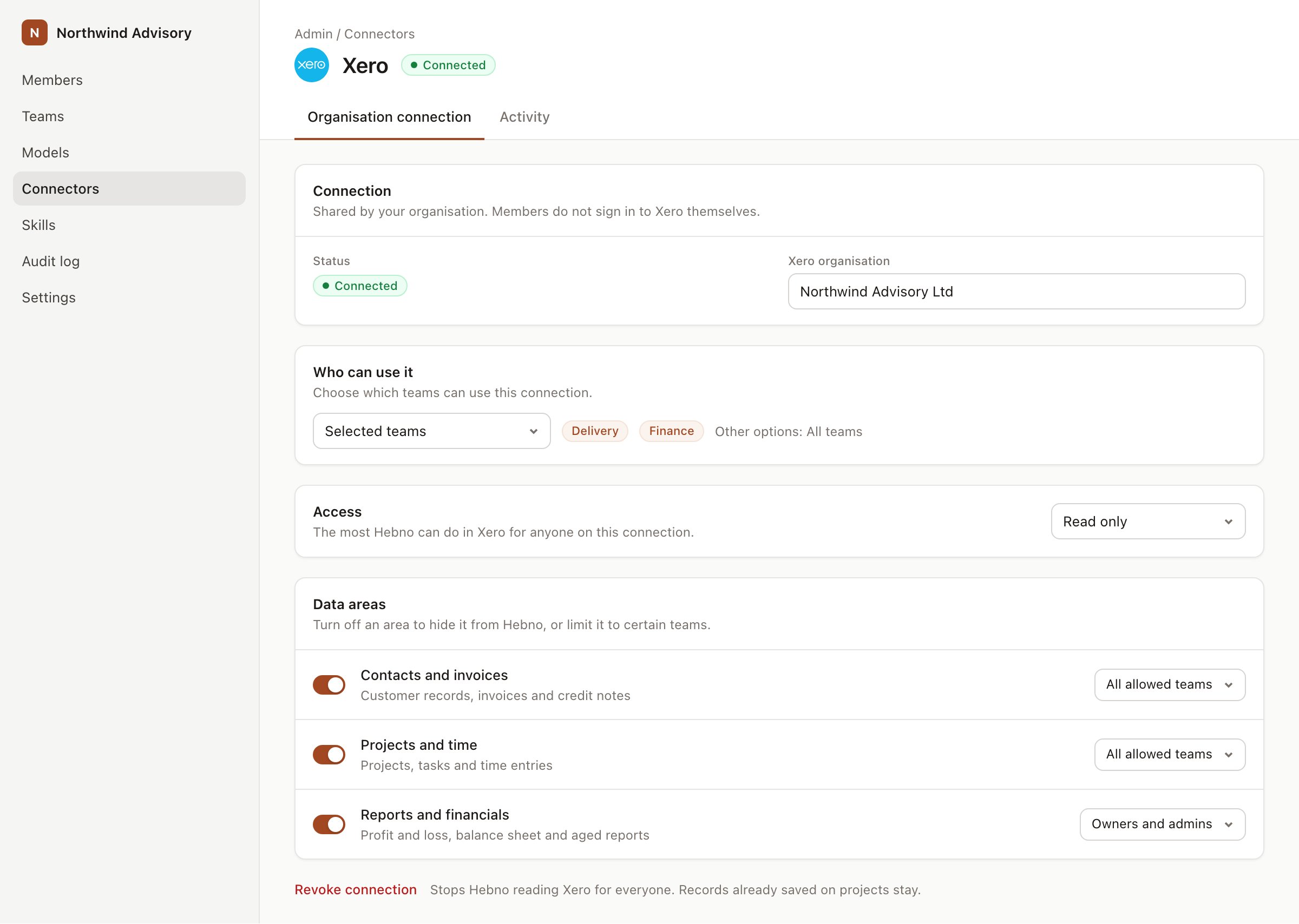
An organisation connection with team access and data areas. Financial figures default to owners and admins.
When a member has linked their own account, Hebno uses that member’s Fortnox rights instead of the organisation connection. Data areas still apply, so a member never sees more through Hebno than both Fortnox and your Hebno settings allow.
What Hebno reads
Reads are live. Hebno queries Fortnox when a request needs it, so figures match what the finance team sees. Only what a reply used is stored with the conversation as its sources.
What Hebno writes
Every write appears first as a confirmation card. You can change any field before you select Confirm. Hebno writes drafts only.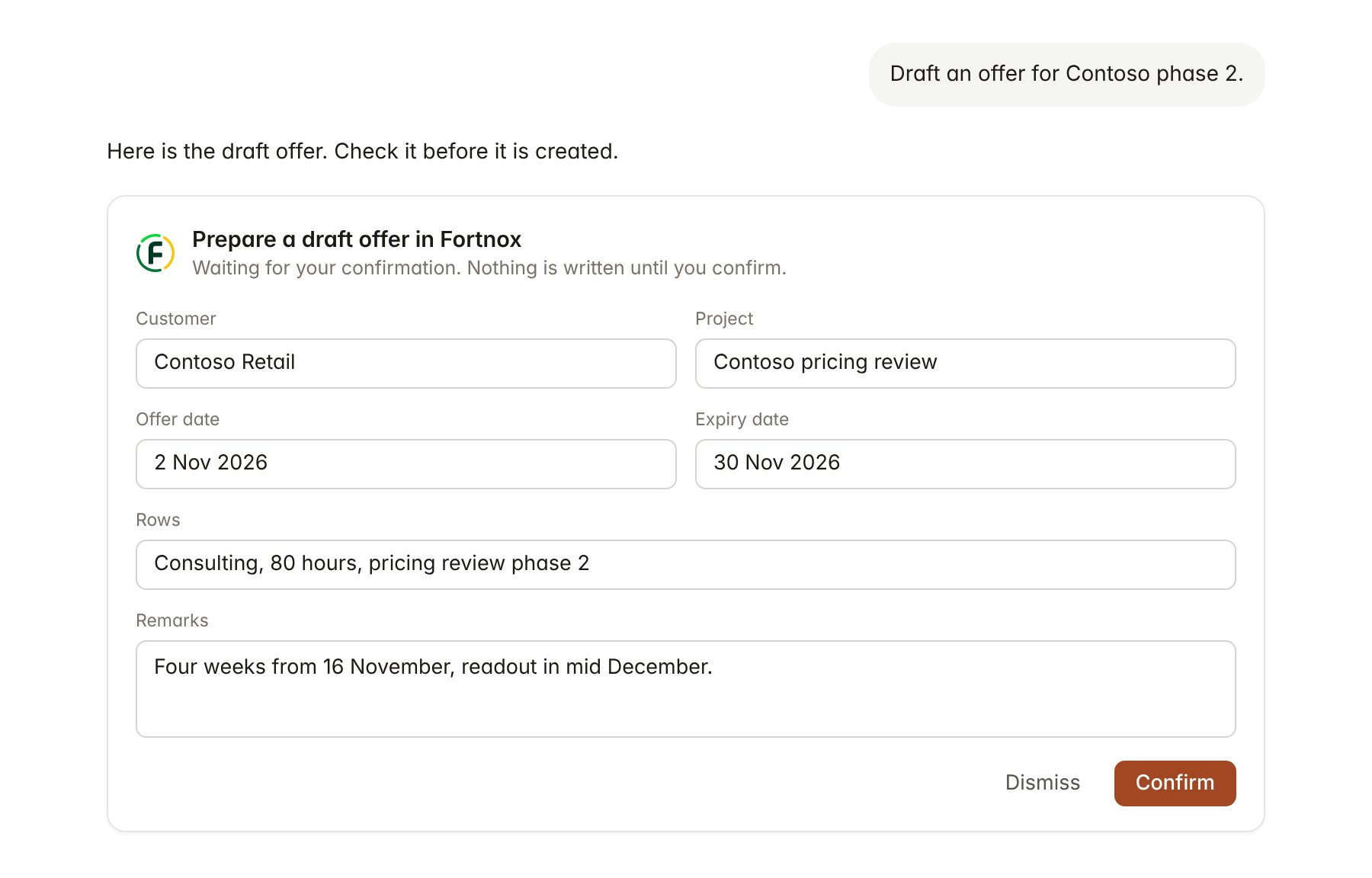
A Fortnox change pending confirmation. Nothing is written until you confirm.
Link a project to Fortnox
Linking marks which Fortnox records belong to a project, so you can ask “what has Contoso been invoiced?” without naming the customer number.- Open the project and select Brain.
- Under Linked records, select Link record, then Fortnox.
- Choose the company, then search and select the customer and each project the engagement uses.
Use Fortnox in chat
-
Attach: open the + menu, choose Sources → Fortnox, and pick a customer, an invoice, an offer, a project or a voucher. Or type
/and choose Fortnox. -
Ask: name the customer, project or period in your request. For example:
List unpaid Contoso Retail invoices and how many days each is past due.
How many hours did the team report on the Contoso pricing review in October 2026?
Prepare a draft offer for Contoso for a four-week pricing review.
- Research runs show a Checking Fortnox step, with a chip for each record it read.
- Agents can read Fortnox on a schedule, for example a Monday summary of invoices past due. Writes an agent proposes appear in agent approvals for review.