

At a glance
Before you start
You need:- An Attio user in the workspace that contains your client records.
- Permission to install apps in that workspace. In Attio, workspace admins manage installed apps under Workspace settings → Apps. If you are not an admin, ask one to install Hebno first.
- An allowed integration. An owner or admin sets Attio to Allow under Admin → Connectors → Catalogue.
Connect Attio
1
Start the connection
Open Settings → Connections, find Attio and select Connect. You can also select Connect from the prompt in a chat.
2
Choose your workspace
Sign in to Attio, choose the workspace if you belong to more than one, review the access Hebno requests and select Authorise.
3
Return to Hebno
The card shows Connected with your Attio workspace name.
What Hebno reads
Reads are live. Hebno queries Attio when a request needs it. Only what a reply used is stored with the conversation as its sources.
What Hebno writes
Every write appears first as a confirmation card. You can change any field before you select Confirm.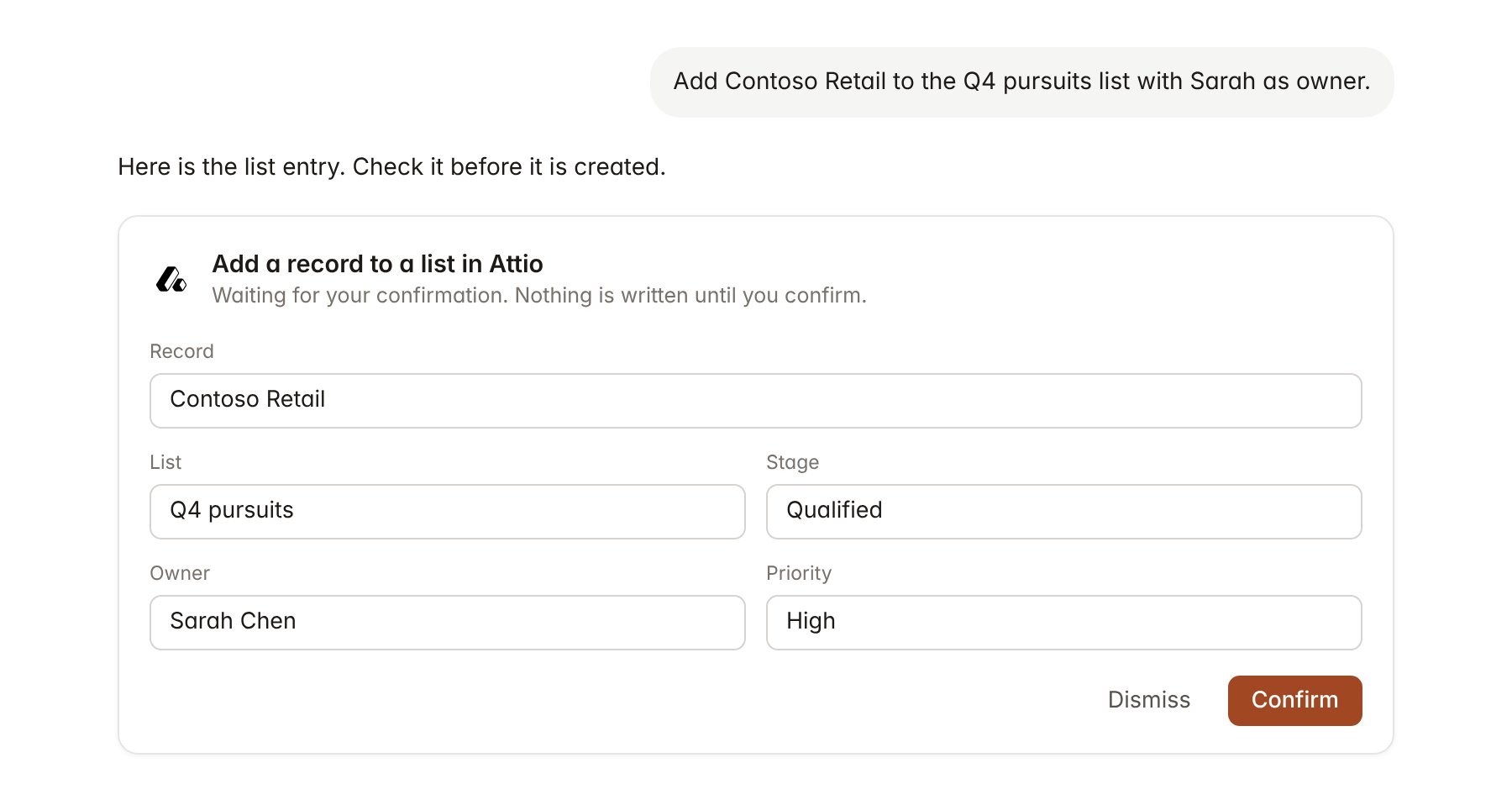
An Attio change pending confirmation. Nothing is written until you confirm.
Link a project to a company and a deal
Linking marks which Attio records belong to a project, so you can ask “what stage is the deal at?” without naming it.- Open the project and select Brain.
- Under Linked records, select Link record, then Attio.
- Search for the company and select it. Repeat to add the deals that belong to the engagement.
Use Attio in chat
-
Attach: open the + menu, choose Sources → Attio, and pick a company, person, deal or list. Or type
/and choose Attio. -
Ask: name the client, contact, deal or list in your request. For example:
Prep me for the Contoso Retail meeting on 12 November: open deals, our strongest connections and the last three notes.
Which entries on the Q4 pursuits list have not moved stage since 1 October, and who owns them?
Set the Contoso Phase 2 deal stage to Proposal sent and add a task for Priya Nair to follow up by 9 November.
- Research runs show a Reviewing Attio step, with a chip for each record, list and note it read.
- Agents can read Attio on a schedule, for example a Monday brief on list entries that have stalled. Writes an agent proposes appear in agent approvals for review.